
OVERVIEW –
The question of whether Invisalign is worth it is one that gets answered differently depending on who you ask. Most patients who go through treatment and wear their aligners consistently think it is. Most patients who are still on the fence have simply not had the right conversation yet.
If you are in Leith or anywhere in north Edinburgh and you have been thinking about this for longer than you would like to admit, a consultation at Newkirkgate Dental Care is a useful first step. Call 0131 554 3509 or visit newkirkgatedental.co.uk to book. There is no commitment and no pressure, just a proper clinical assessment and a straight answer about what treatment would look like for you specifically.
Is Invisalign Worth It? Here’s What Leith Patients Actually Say
Most people who have been thinking about Invisalign for a while already know what it is. Clear removable aligners, no fixed braces, worn for twenty-two hours a day, changed every week or two. The theory is straightforward. But the question that comes back time and again, the one that determines whether someone actually books a consultation or keeps researching indefinitely, is a simpler one.
Is it actually worth it?
Not the clinical version of that question. The real version. Does it work? Is it comfortable? Does it disrupt your life? Is the cost justifiable? And honestly — do people notice?
This post tries to answer that question properly, drawing on what patients who have been through Invisalign treatment at our Leith practice actually experience. No glossy promises. Just the genuine picture.
What Invisalign Actually Does
Before getting into whether it is worth it, it is worth being clear about what Invisalign actually does, because there is a reasonable amount of confusion in the market about this.
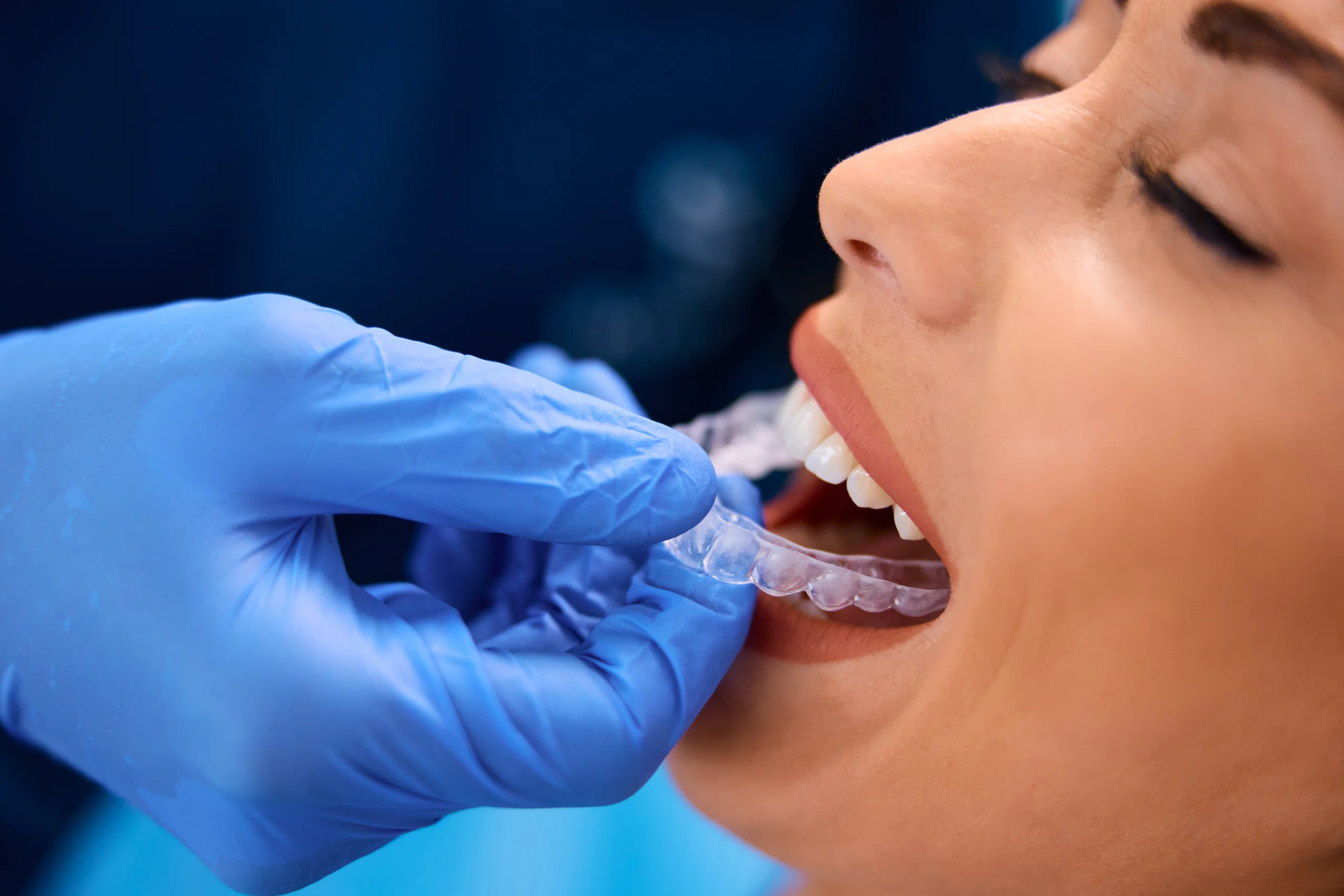
Invisalign is an orthodontic treatment. It moves teeth. It uses a series of custom-made clear plastic aligners, each one applying gentle pressure to specific teeth, to shift them gradually into a planned final position. The aligners are made from precise digital scans or impressions of your teeth, and the full series is designed using software that plans every movement from your starting point to the end result.
It is not whitening. It is not a cosmetic veneer. It will not change the shape or colour of your teeth. What it will do, if you are a suitable candidate and you wear the aligners consistently, is move your teeth into a significantly better alignment over the course of treatment.
For the right patient, with the right expectations, the results are genuine and lasting.
Who Is Invisalign Actually Suitable For?
Invisalign is suitable for adults and older teenagers with mild to moderate alignment concerns including crowding, spacing, overbite, underbite and crossbite. It is not appropriate for severe malocclusions or significant skeletal issues, which typically require fixed braces or combined orthodontic and surgical treatment. A consultation at Newkirkgate Dental Care in Leith will confirm suitability based on a full clinical assessment.
This is one of the things that gets glossed over in a lot of Invisalign marketing, and it is worth being direct about. Invisalign is excellent for mild to moderate alignment concerns. It is less effective for severe cases. And there are some orthodontic situations where it simply is not the right tool.
Patients who tend to get the best results from Invisalign are those with crowded front teeth that are preventing them from feeling confident about their smile, small gaps that have been there since their teens, post-orthodontic relapse where teeth have shifted from a previously treated position, or a slight overbite or uneven bite that affects both function and appearance.
Patients who are better suited to fixed braces are those with severe crowding, complex bite discrepancies, significant rotation of back teeth, or skeletal issues where the underlying jaw structure needs to be considered as part of the treatment plan.
If you book a consultation at Newkirkgate and Invisalign is not the right option for your situation, we will tell you that. A recommendation that saves you time and money is not a bad consultation.
What is it actually like to wear Invisalign every day?
Most Invisalign patients adapt to wearing aligners within the first week. The aligners are comfortable after the initial few days and virtually invisible to others. Aligners are removed for eating and drinking, which some patients find inconvenient. New aligners typically cause mild pressure or tightness for one to two days, which settles quickly. Wearing the aligners for the required twenty to twenty-two hours per day is the single most important factor in achieving the planned result.
The first week is the hardest. There is a brief adjustment period where the aligners feel bulky, the tongue is not sure what to make of the new occupant, and there may be a very slight change in speech, usually a mild lisp that passes within a few days. Most patients are surprised by how quickly this settles.
After that first week, the routine becomes second nature. You take the aligners out to eat, clean your teeth, and put them back. You progress to the next aligner every one to two weeks. You have occasional progress appointments. And every time you move to a new aligner, there is mild pressure or tightness for a day or two that tells you the teeth are moving as planned.
The inconvenience most commonly mentioned by patients is not the aligners themselves but the eating routine. You have to remove the aligners to eat, which means spontaneous snacking in public requires a moment of planning that did not exist before. Some patients find this is an unexpected benefit for their eating habits. Others find it a mild irritation. Neither response is wrong.
The Results, What Patients at Newkirkgate Actually Experience
Patients who complete Invisalign treatment at Newkirkgate and wear their aligners consistently typically describe three things when they reflect on the experience.
The first is that the results are more significant than they expected. Photographs taken before treatment and after frequently show changes that are genuinely striking, even in cases that seemed mild on paper. Moving teeth even a small amount changes the whole appearance of a smile.
The second is that they wish they had done it sooner. This is perhaps the most common thing we hear. Patients who spent years feeling self-conscious about their teeth, who had been meaning to do something about it but kept putting it off, frequently express something between frustration at themselves and relief at having finally acted.
The third is that the process was less disruptive than they imagined. The expectation of Invisalign is often coloured by memories or assumptions about fixed braces, the tightening appointments, the dietary restrictions, the visible hardware. Invisalign does not carry any of those associations. Most patients report that after the first week, treatment becomes a quiet background feature of daily life rather than something they think about constantly.
How much does Invisalign cost in Leith, Edinburgh?
Invisalign costs in Leith at Newkirkgate Dental Care are to be confirmed depending on the complexity of the case. Contact the practice on 0131 554 3509 or visit newkirkgatedental.co.uk to book a consultation where a full treatment plan and written cost breakdown will be provided. Patient finance through Tabeo is available to spread the cost into manageable monthly payments, including interest-free options.
The cost of Invisalign in Edinburgh varies by practice and by case complexity. Simpler cases involving minor crowding or small gaps are typically at the lower end of the range. More complex cases involving multiple movements across multiple teeth are priced accordingly.
Patient finance through Tabeo at Newkirkgate allows you to spread the cost into monthly payments, which changes the calculation significantly for many patients. When the cost of treatment is divided into a monthly payment that fits within a normal budget, the “is it worth it” question often answers itself.
The way to think about value here is not to compare the cost of Invisalign against doing nothing. The right comparison is Invisalign against the alternative, which is typically fixed braces, and against the ongoing cost of feeling self-conscious about your teeth every day for the next decade.
Neither of those alternatives is free.
Leith as the Setting, Why Location Actually Matters for Orthodontic Treatment
This might seem like an odd thing to include in a blog post about Invisalign, but bear with it for a moment.
Orthodontic treatment requires a reasonable number of appointments over the course of several months to a year or more. Progress checks, aligner collection, refinements, the final retainer fitting. Whether those appointments are something you dread or something you fit easily into your routine depends partly on how easy it is to get to the practice.
Newkirkgate Dental Care is inside Newkirkgate Shopping Centre on Great Junction Street in Leith, on the corner of Leith Walk and Great Junction Street. Over a dozen bus routes stop outside the shopping centre. For patients who live in Leith, Pilrig, Newhaven, Trinity or the surrounding north Edinburgh area, the practice is genuinely convenient. The kind of convenient that means appointments get kept rather than rescheduled repeatedly.
For an orthodontic treatment that depends on consistent wear and regular monitoring, making it easy to attend appointments is not a trivial detail.
The Honest Summary, Is Invisalign Worth It?
For the right patient, wearing their aligners consistently, with realistic expectations about what treatment can achieve, yes. Invisalign is worth it.
The results are real. The process is less disruptive than most patients expect. The clinical evidence behind the system is extensive. And the impact of straighter teeth on daily confidence is something patients describe in ways that are difficult to quantify but impossible to dismiss.
The honest caveat is that Invisalign only works if you wear the aligners. Twenty-two hours a day is not a suggestion. It is the clinical requirement for achieving the planned tooth movement. Patients who wear their aligners fifteen or sixteen hours a day and wonder why their treatment is running behind schedule are not getting the value of the investment they have made.
The other honest note is that suitability matters. A consultation is not a commitment. It is thirty minutes with a dentist who will tell you whether Invisalign is appropriate for your situation, what the plan would look like, and what it would cost. That information is worth having whether you go ahead with treatment or not.