
White Fillings in Leith
White composite fillings restore your tooth and look completely natural doing it. No dark patches, no metallic glint, just a filling that matches your tooth so well most people won’t know it’s there.
OVERVIEW
Newkirkgate Dental Care at 2 Great Junction Street, Leith, Edinburgh EH6 5LA provides white composite fillings for NHS and private patients in Leith, Edinburgh. White fillings are tooth-coloured restorations that blend naturally with the surrounding tooth, used to treat decay, replace old amalgam fillings and repair chipped or damaged teeth. White fillings are available on the NHS for front teeth and privately for back teeth where patients prefer a tooth-coloured option. To book a consultation about white fillings in Leith, call 0131 554 3509 or visit newkirkgatedental.co.uk.
Fillings That Look Like Nothing Is There
For a long time, having a filling meant accepting a dark grey patch in your tooth for the rest of your life. Amalgam, the silver-coloured material used in traditional fillings, was the standard option, and it did the job clinically. But it never looked good, and for teeth near the front of the mouth it could be genuinely conspicuous.
White composite fillings changed that. Made from a tooth-coloured resin material that bonds directly to the tooth, composite fillings are shaped and polished to match the colour, texture and appearance of the surrounding tooth. When they’re done well, they’re essentially invisible. You can smile, laugh and eat without thinking about whether anyone can see your fillings.
At Newkirkgate we use tooth-coloured composite for fillings wherever it is clinically appropriate. White fillings are available on the NHS for front teeth and as a private option for back teeth, giving patients the choice of a natural-looking restoration wherever they need it.
What Are White Composite Fillings?
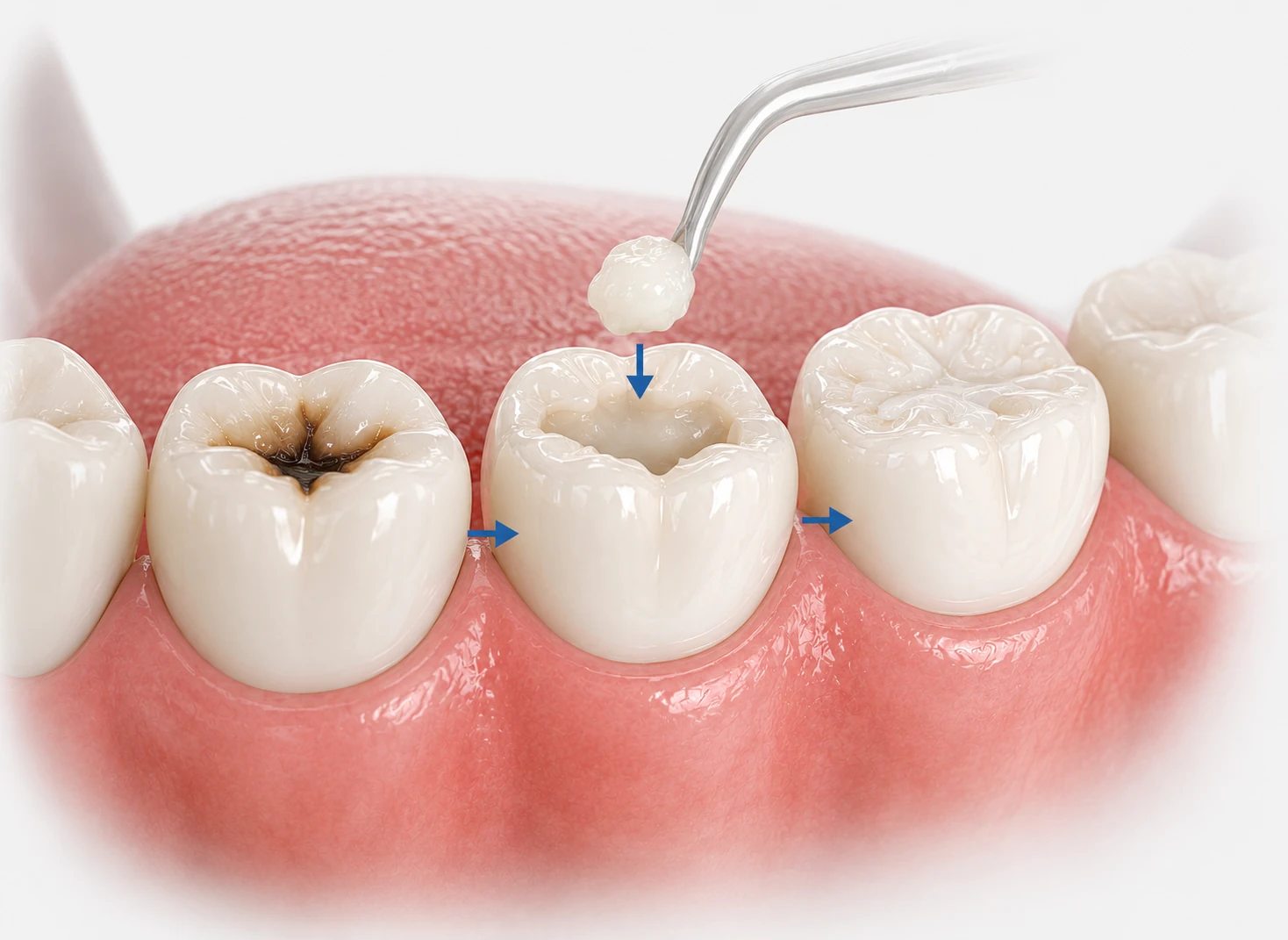
A composite filling is made from a mixture of resin and fine glass or ceramic particles. The material is applied to the tooth in layers, each one hardened using a curing light, then shaped and polished to match the surrounding tooth surface. The result is a restoration that is bonded directly to the tooth structure, not simply packed into the cavity like amalgam, which means less healthy teeth often need to be removed during preparation.
Composite is a versatile material. It’s used for straightforward decay repair, for replacing old amalgam fillings, for repairing chipped or fractured teeth, and in some cases for cosmetic improvements such as closing small gaps or reshaping the edge of a tooth. It forms the basis of composite bonding, a cosmetic treatment that uses the same material more extensively to transform the appearance of teeth.
White Fillings vs Amalgam, What’s the Difference?
White Composite | Amalgam | |
Appearance | Tooth-coloured, blends naturally | Silver-grey, visible against tooth |
Bonding | Bonds directly to tooth structure | Mechanically packed into cavity |
Tooth preparation | Less healthy tooth removed | More tooth may need to be removed |
NHS availability | Front teeth as standard, back teeth private | Available for back teeth on NHS |
Durability | Very good, typically 7 to 10+ years | Very good, long clinical track record |
Suitability | Front and back teeth | Back teeth primarily |
Both materials have a strong clinical track record. Amalgam is a robust, long-lasting material and remains an appropriate choice for many back tooth restorations on the NHS. White composite is increasingly the preferred option for patients who want a natural appearance and for front teeth, it is the standard NHS option.
The right choice depends on the location of the filling, the size of the cavity and your own preferences. Your dentist will always explain both options and the costs involved before anything is agreed.
What to Expect During Your Filling Appointment
-
1Local AnaestheticUnless the cavity is very small and superficial, a filling is carried out under local anaesthetic. We apply topical numbing gel to the gum first, then administer the injection slowly to minimise discomfort. You should feel pressure but not pain throughout. If something doesn't feel numb enough, tell us and we address it before continuing.
-
2Removing the DecayOnce the tooth is numb, your dentist removes the decayed tooth structure using a dental drill or, where appropriate, hand instruments. The goal is to remove all the decay while preserving as many healthy teeth as possible. With composite fillings, less tooth typically needs to be removed than with amalgam because the material bonds to the tooth rather than being packed in.
-
3Preparing the SurfaceThe cavity is cleaned, dried and etched with a mild acid solution that creates a microscopically rough surface for the composite to bond to. A bonding agent is then applied and cured with a light.
-
4Placing the CompositeThe composite resin is applied in thin layers. Each layer is shaped carefully to restore the natural contours of the tooth and hardened using a curing light. The number of layers depends on the size of the cavity. Your dentist builds the filling up gradually to ensure a strong, well-adapted result.
-
5Shaping and PolishingOnce the filling is fully placed and cured, your dentist shapes and polishes it so it fits your bite correctly and looks as natural as possible. You will be asked to bite down on articulating paper, a thin, inked paper, to check that the filling is not too high before the appointment ends. The whole appointment, from anaesthetic to polishing, typically takes between 30 and 60 minutes depending on the size and complexity of the cavity.
Replacing Old Amalgam Fillings
Many patients ask about having their existing amalgam fillings replaced with white composite. There are two situations where this makes sense:
When the old filling has failed: Amalgam fillings do not last forever. Over time, the seal between the filling and the tooth can break down, allowing bacteria to penetrate beneath the filling and cause secondary decay. A filling that has cracked, fractured, or where decay has developed underneath it needs to be replaced regardless of the material used. In these cases, replacing it with white composite is a straightforward decision.
When the filling is still sound but the appearance is the concern: If an amalgam filling is still clinically sound, no decay, no cracking, no leakage, replacing it purely for cosmetic reasons involves removing healthy tooth structure along with the old filling. Your dentist will give you an honest assessment of whether the cosmetic benefit is worth that trade-off in your specific case. In some cases it absolutely is. In others, the better advice is to leave a sound filling in place and replace it with composite when it eventually needs replacement.
We will never recommend removing a sound filling unnecessarily. The decision is always made based on what is genuinely in your best interest.
NHS and Private Options for White Fillings
NHS White Fillings: On the NHS in Scotland, white composite fillings are provided as standard for front teeth, the teeth visible when you smile. For back teeth, the NHS standard restoration is amalgam. This is not about cost-cutting, amalgam remains a clinically appropriate material for back teeth, but it is a distinction that matters to patients who want a uniform natural appearance throughout their mouth.
Private White Fillings: If you would prefer a white composite filling on a back tooth, this is available as a private treatment. Your dentist will confirm the cost at your consultation. The procedure is identical, the difference is simply the material used and the associated charge.
Under the NHS in Scotland, you pay 80% of the treatment cost up to a maximum of £384 per course of treatment. Patients under 26, and those who qualify for free NHS dental treatment, pay nothing.
Private white fillings can be included in a Tabeo finance plan if you are having multiple fillings or other private treatment at the same time.
White Fillings and Composite Bonding, What's the Connection?
Composite bonding uses the same tooth-coloured resin material as white fillings, but applied more extensively to improve the appearance of teeth rather than purely to restore them after decay.
If you are interested in composite bonding, to close gaps, reshape teeth, repair chips or improve the overall appearance of your smile, speak to your dentist at your consultation. The two treatments are often discussed together and, depending on what you’re looking for, a combination approach may be the most effective solution.
No sure where to begin? Just give us a ring.
Make an Enquiry
Why Edinburgh Residents Choose Newkirkgate Dental
Proudly serving patients across Edinburgh and Leith for over two decades, from our practice inside Newkirkgate Shopping Centre on Great Junction Street.
Masters in Implants
Our principal dentist holds a postgraduate Masters degree in dental implantology.
Phobia Friendly
Every member of our team is trained to work with nervous patients.
NHS & Private
Full NHS care and private treatments, all under one roof in Leith.
Open Saturdays
We're open Saturday mornings so dentistry fits around your week.
REGISTRATION
Register With Newkirkgate Dental Care
Whether you’re new to Leith, new to Edinburgh, or just long overdue a visit, we’d love to have you. We’re accepting new NHS and private patients right now, and getting registered takes just a few minutes. Once you’re with us, we’ll take care of everything else.
- Free NHS check-up every 12 months, no bill at the end
- Same-day emergency slots held back for registered patients every day
- Open Monday to Friday and Saturday mornings
- Every member of our team is trained to work with nervous patients
- NHS and private care, the same warm welcome either way
We’re inside Newkirkgate Shopping Centre on Great Junction Street, right next to Boots. Walk in, give us a call, or register online, whichever feels easiest.
FAQs
Frequently Asked Questions About Dental Check up
Yes, for front teeth. White composite fillings are the NHS standard for teeth visible when you smile. For back teeth, the NHS provides amalgam as the standard restoration. If you would prefer a white filling on a back tooth, this is available as a private treatment. Your dentist will explain both options and the costs clearly before anything is agreed.
With good oral hygiene and regular check-ups, white composite fillings typically last between seven and ten years or longer. The lifespan depends on the size of the filling, its location in the mouth and how well the tooth is looked after. Back teeth fillings experience more biting force and may wear more quickly than front tooth fillings. Your dentist will monitor your fillings at your check-ups and let you know when any are approaching the end of their useful life.
The procedure is carried out under local anaesthetic, so you should not feel pain during the appointment. Some sensitivity in the treated tooth for a few days afterwards is normal, particularly to hot, cold and sweet. This usually settles within a week or two. If sensitivity persists or worsens, call us and we will check the filling.
Composite resin can absorb staining from food and drink over time, particularly from tea, coffee, red wine and smoking. The surface of the filling can be polished at your hygiene appointments to remove surface staining. Over many years, the colour of a white filling may shift slightly relative to the natural tooth around it. This is one of the reasons good oral hygiene and regular hygiene appointments help to maintain the appearance of composite restorations.
Technically yes, but replacing multiple fillings in one session is demanding and may not be the most comfortable experience. We would usually recommend replacing fillings one or two at a time, starting with those that are most in need of replacement. If you are keen to replace several amalgam fillings, your dentist will help you plan a sensible schedule. We will always be honest about whether a filling genuinely needs replacing or whether leaving it in place is the better clinical decision.