
Porcelain Crowns in Leith, Edinburgh
A check-up every six months is one of those things that’s easy to put off and genuinely worth not doing. Book yours at Newkirkgate and we’ll take proper care of it.
OVERVIEW
Newkirkgate Dental Care at 2 Great Junction Street, Leith, Edinburgh EH6 5LA provides porcelain crowns for NHS and private patients in Leith and across Edinburgh. A dental crown is a custom-made cap that fits over the entire visible surface of a tooth to restore its strength, shape and appearance. Porcelain crowns are available as a private option and produce natural-looking results. On the NHS, metal or metal-ceramic crowns are the standard provision for back teeth. Inlays and onlays are also available for suitable cases. To book a crown consultation, call 0131 554 3509 or visit newkirkgatedental.co.uk.
Restoring Your Tooth, Right Here in Leith
A damaged tooth is more than an aesthetic concern. When a tooth has been significantly weakened by a large filling, cracked by an accident, treated with root canal therapy or broken under biting forces, the remaining structure needs protection. Left unsupported, a weakened tooth is at high risk of fracturing further, potentially to the point where it can no longer be saved.
A porcelain crown wraps around the entire visible surface of the tooth, restoring its original shape and protecting the underlying structure from further damage. It looks like a natural tooth, bites like a natural tooth, and with proper care, lasts for many years.
We provide crown treatment for patients from across Edinburgh, including patients from Portobello, Newhaven, Trinity, Inverleith, Bonnington and the city centre, as well as the local Leith community right on our doorstep in Newkirkgate Shopping Centre.
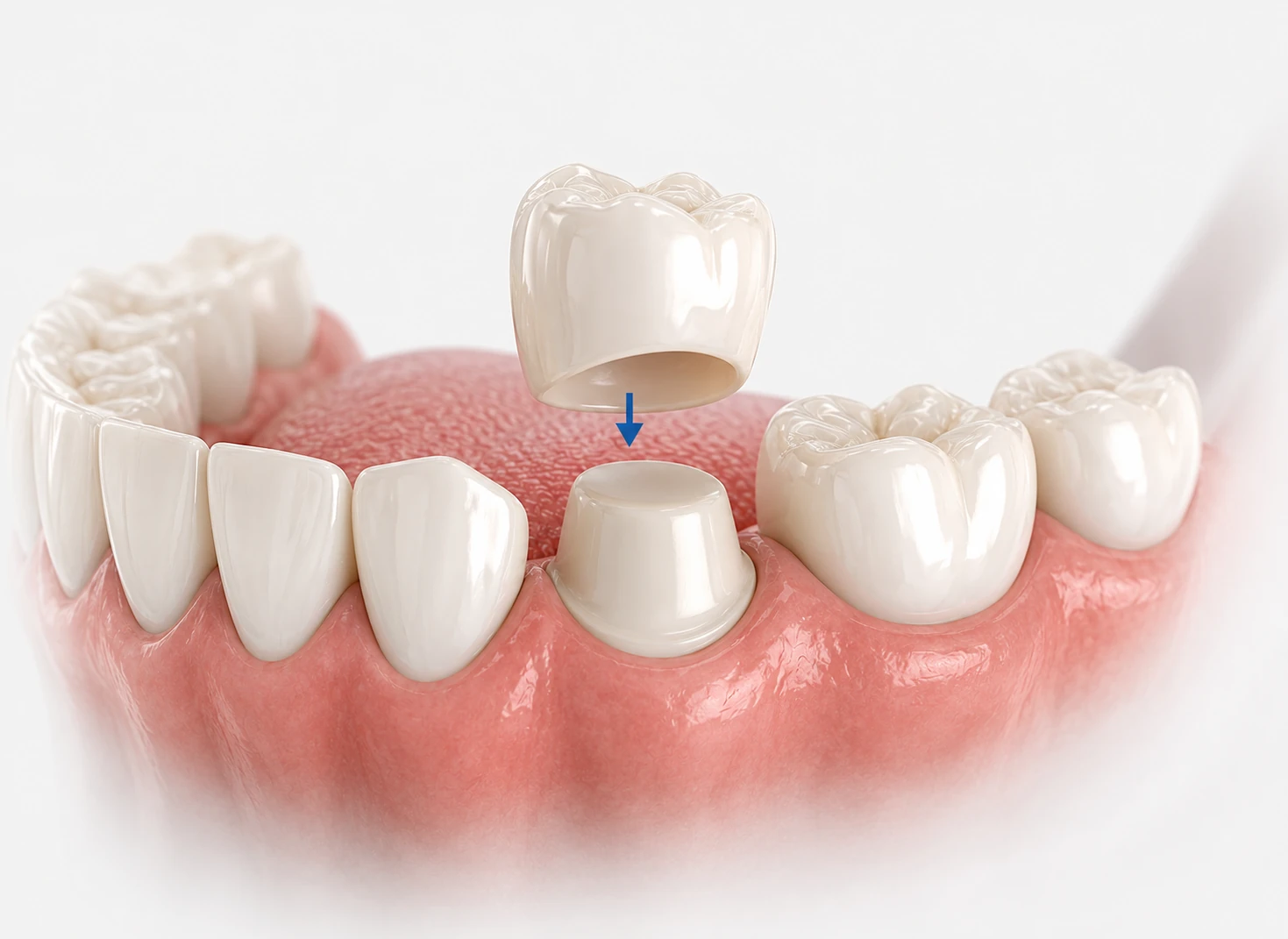
When Is a Dental Crown the Right Treatment?
Your dentist will recommend a crown when a tooth has been damaged to the point where a filling alone is no longer sufficient to restore it. Common situations include:
- A tooth with a large filling where the remaining natural tooth structure is insufficient to support another filling
- A tooth that has cracked or fractured, where the crack is below the level of a conventional filling but the root is still sound
- A tooth following root canal treatment, where the tooth is at risk of fracturing without the protection a crown provides
- A tooth that has worn down significantly through grinding or acid erosion
- A broken tooth where the visible portion needs rebuilding
- A tooth used as an anchor for a dental bridge
In each of these cases, the crown restores the tooth to full function and protects it from further damage. It is a treatment designed to save a tooth that would otherwise be at serious risk.
What Types of Crown Are Available at Newkirkgate?
-
1Porcelain Crowns (Private)Full porcelain crowns are made entirely from high-quality ceramic and produce the most natural-looking result. They match the colour, translucency and texture of the surrounding natural teeth with impressive accuracy. Porcelain crowns are suitable for both front and back teeth and are the preferred private option for patients who want the best aesthetic outcome.
-
2Metal-Ceramic Crowns (NHS Standard)Metal-ceramic crowns have a metal substructure with a porcelain outer layer. They are extremely strong and durable, making them well-suited to back teeth that experience high biting forces. The metal base can sometimes cause a dark line at the gum margin over time. On the NHS, metal-ceramic crowns are the standard provision for back teeth.
-
3Metal Crowns (NHS, Back Teeth)Full metal crowns, typically made from gold alloy or other dental metals, are the most durable option available and are sometimes recommended for back teeth where strength is the primary concern and aesthetics are less critical.
-
4Inlays and OnlaysFor teeth that are too damaged for a filling but do not require a full crown, an inlay or onlay may be the most appropriate solution. An inlay fits within the cusps of the tooth; an onlay covers one or more cusps. Both are custom-made in a dental laboratory and bonded to the tooth. They preserve more natural tooth structure than a full crown while still providing a strong, stable restoration.
What Happens During Crown Treatment
Assessment and Planning
Your dentist carries out a full assessment of the tooth, including X-rays to check the root and surrounding bone. They discuss the type of crown most appropriate for your situation and explain the costs for both NHS and private options.
Tooth Preparation
The tooth is shaped under local anaesthetic to create space for the crown. The amount of tooth removed depends on the type of crown being fitted. A temporary crown is placed to protect the prepared tooth while the permanent crown is being fabricated in the laboratory.
Impressions and Laboratory Fabrication
Precise impressions or digital scans of the prepared tooth and surrounding teeth are taken and sent to the laboratory. The crown is custom-made to fit the prepared tooth precisely and match the colour and shape of the adjacent teeth. This typically takes one to two weeks.
Fitting the Crown
At the fitting appointment, the temporary crown is removed and the permanent crown is checked for fit, shape and colour before being permanently cemented in place. Your bite is checked carefully and any adjustments made before you leave.
NHS and Private Crown Options
Crown treatment is available on the NHS where there is a clinical need. Under the Scottish NHS charge system, you pay 80% of the treatment cost up to a maximum of £384 per course of treatment. The NHS provides metal-ceramic or full metal crowns for back teeth. For front teeth in the smile line, a tooth-coloured option is provided as standard.
If you would prefer a full porcelain crown on a back tooth for aesthetic reasons, or want a higher-specification ceramic material, this is available as a private treatment. Your dentist will explain both options and the cost of each clearly before anything is agreed.
Patients under 26, or those who qualify for free NHS dental care, receive their crown treatment free of charge.
No sure where to begin? Just give us a ring.
Make an Enquiry
Flexible Payment Options for Porcelain Crowns
Private crown treatment is available with patient finance through Tabeo, allowing you to spread the cost into manageable monthly payments. Interest-free and low-cost options are available, and there is no early repayment penalty.
- Interest-free and low-cost finance options available
- Fixed monthly payments by direct debit that never change
- Simple, straightforward application process
- No early repayment penalty
- Finance can cover your full treatment plan including any preparatory work
Speak to our team at your consultation and we will walk you through all available options. There is no obligation and no pressure to apply.
REGISTRATION
Register With Newkirkgate Dental Care
Whether you’re new to Leith, new to Edinburgh, or just long overdue a visit, we’d love to have you. We’re accepting new NHS and private patients right now, and getting registered takes just a few minutes. Once you’re with us, we’ll take care of everything else.
- Free NHS check-up every 12 months, no bill at the end
- Same-day emergency slots held back for registered patients every day
- Open Monday to Friday and Saturday mornings
- Every member of our team is trained to work with nervous patients
- NHS and private care, the same warm welcome either way
We’re inside Newkirkgate Shopping Centre on Great Junction Street, right next to Boots. Walk in, give us a call, or register online, whichever feels easiest.
FAQs
Frequently Asked Questions About Porcelain Crowns
Porcelain crown fees at Newkirkgate Dental Care in Leith are to be confirmed. Contact the practice on 0131 554 3509 for current pricing. NHS crown treatment is available where clinically appropriate, with patients paying 80% of the treatment cost up to a maximum of £384 per course. Private crown treatment is available with finance through Tabeo, allowing you to spread the cost into manageable monthly payments.
Porcelain crowns typically last between ten and fifteen years or longer with good oral hygiene and regular dental check-ups. Longevity depends on the material used, the location of the crown, and the patient's habits. Patients who grind their teeth are usually recommended a night guard to protect their crowns. Crowns on back teeth experience more biting force and may wear more quickly than those on front teeth.
Crown preparation is carried out under local anaesthetic, so you should not feel pain during the appointment. Some tenderness around the prepared tooth and gum for a day or two after preparation is normal. The temporary crown may feel slightly different from your natural teeth, which is expected. Once the permanent crown is fitted, most patients find it feels completely natural within a few days.
Yes. In fact, a crown is usually recommended following root canal treatment on a back tooth. Root-treated teeth lose the living pulp that keeps them hydrated and can become more brittle over time, making them more prone to fracturing. A crown protects the tooth and significantly extends its useful life after root canal therapy.
No. A crown covers the entire visible surface of the tooth, from the gum margin upwards, and requires more extensive preparation. A veneer covers only the front surface of the tooth and requires minimal preparation. Crowns are used primarily to restore structural integrity to a damaged or weakened tooth. Veneers are used primarily for cosmetic improvement of healthy teeth. Your dentist will recommend the most appropriate option for your situation at your consultation.