
Root Canal Treatment in Leith
Root canal treatment has an undeserved reputation. Done well, with proper anaesthetic and a calm approach, most patients are surprised by how straightforward it actually is. We save teeth every week that patients assumed were beyond help.
OVERVIEW
Newkirkgate Dental Care at 2 Great Junction Street, Leith, Edinburgh EH6 5LA provides root canal treatment for NHS and private patients. Principal dentist Fotis Bousis has a particular interest and additional training in root canal therapy. Root canal treatment is used to save a tooth where the nerve has become infected or damaged, removing infection and sealing the tooth to prevent further problems. The procedure is carried out under local anaesthetic and is significantly more comfortable than most patients expect. To book a root canal consultation in Leith, call 0131 554 3509 or visit newkirkgatedental.co.uk.
Root Canal Treatment, Let's Clear Up the Reputation
Root canal treatment is one of the most feared dental procedures and one of the most misunderstood. The fear comes from a time when techniques and anaesthesia were far less advanced than they are today. Modern root canal treatment, carried out well, is no more uncomfortable than having a filling. In many cases it’s less uncomfortable than the toothache that preceded it.
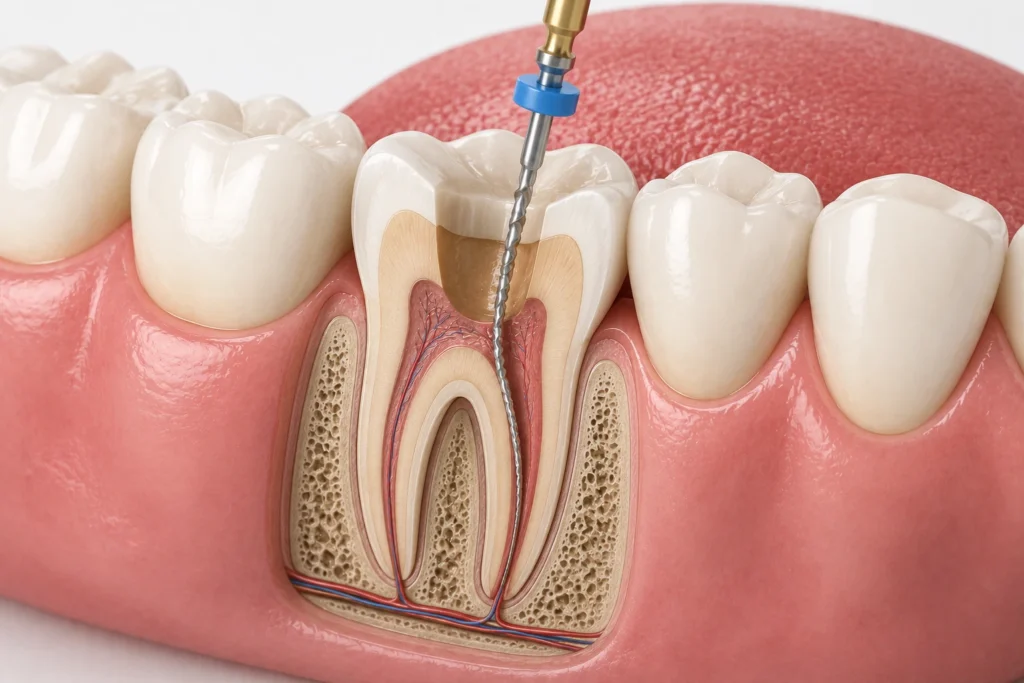
The purpose of root canal treatment is to save a tooth. When the nerve inside a tooth becomes infected or damaged, through decay, trauma or a cracked tooth, the infection needs to be removed before it spreads further and causes an abscess or requires extraction. Root canal treatment removes that infection, cleans and shapes the root canals, and seals the tooth so it can continue to function normally for many years.
The alternative to root canal treatment is usually extraction. Keeping your natural tooth is almost always the better outcome, for your bite, your jawbone, the surrounding teeth, and your long-term dental health. If root canal treatment can save your tooth, it is worth doing.
Signs You Might Need Root Canal Treatment
Root canal treatment is needed when the pulp, the soft tissue inside the tooth containing the nerve and blood vessels, becomes infected or dies. This can happen gradually or as a result of trauma. Common signs include:
- Persistent toothache: Deep, throbbing pain that doesn’t settle, particularly if it’s keeping you awake at night
- Prolonged sensitivity: Pain from hot or cold that lingers long after the stimulus is removed, rather than passing quickly
- Pain when biting or chewing: Particularly on one specific tooth
- Swelling of the gum: A raised, tender swelling near the root of the tooth, sometimes called a gum boil or dental abscess
- Darkening of the tooth: A tooth that has become noticeably darker than the surrounding teeth may have a dying nerve
- A persistent bad taste: Caused by infection draining from around the root of the tooth
Sometimes a tooth that needs root canal treatment causes no pain at all, particularly if the nerve has already died. This is one of the reasons regular check-ups matter, X-rays can identify infection at the root of a tooth before it becomes acutely painful.
If you have any of these symptoms, call us on 0131 554 3509. Don’t wait for the pain to become unbearable.
What Happens During Root Canal Treatment
Root canal treatment typically takes one to three appointments depending on the complexity of the case and the number of canals in the tooth. Here is what to expect at each stage.
-
1Step 1 — Assessment and X-RayBefore treatment begins, your dentist takes an X-ray to assess the extent of the infection and the shape of the root canals. This gives them the information they need to plan the procedure accurately.
-
2Step 2 — Local AnaestheticThe tooth and surrounding area are thoroughly numbed with local anaesthetic before anything begins. We take our time with this — applying topical numbing gel first, then allowing full time for the anaesthetic to work before proceeding. If at any point something doesn't feel numb enough, we stop and address it. You should feel pressure during treatment but not pain.
-
3Step 3 — Removing the Infected PulpOnce the tooth is fully numb, a small opening is made in the crown of the tooth to access the pulp chamber and root canals. The infected or damaged pulp tissue is carefully removed using fine specialist instruments.
-
4Step 4 — Cleaning and Shaping the CanalsThe root canals are cleaned, shaped and disinfected using a combination of instruments and irrigating solutions. This removes all traces of infection and prepares the canals for filling. The number of canals varies depending on the tooth — front teeth typically have one, back teeth can have three or four.
-
5Step 5 — Filling the CanalsOnce the canals are clean and dry, they are filled with a biocompatible material called gutta-percha, which seals the canals and prevents reinfection. A temporary or permanent filling is then placed in the access opening.
-
6Step 6 — Crown or RestorationIn most cases, a tooth that has had root canal treatment will need a crown to protect it. Root-treated teeth can become more brittle over time, and a crown provides the structural support needed to keep the tooth functional for the long term. Your dentist will discuss this at your appointment and include it in your treatment plan.
In Experienced Hands
Root canal treatment at Newkirkgate is carried out by our clinical team, with principal dentist Fotis Bousis having a particular interest and extensive experience in root canal therapy. Fotis graduated from Athens in 2009 and has since completed additional training across a range of specialist areas. Patients consistently mention his calm, unhurried approach in their reviews, something that matters significantly in a procedure that carries so much undeserved anxiety.
“I’ve had two lots of root treatment which was certainly a lot easier than I had built it up to be in my mind. Fotis is excellent as are the rest of the team, really friendly and helpful. I’m now actually looking forward to having more work done.”
Jason, Edinburgh
“After some horrible experiences with dentists in the past, this practice is a real breath of fresh air. I’ve had root canal treatment here and it was the most stress-free and pain-free experience ever.”
Lee, Edinburgh
NHS and Private Options
Root canal treatment is available on the NHS where it is clinically appropriate. Under the NHS in Scotland, you pay 80% of the treatment cost up to a maximum of £384 per course of treatment. For patients under 26, or those who qualify for free NHS dental care, the treatment is completely free.
A private root canal option is also available, which may offer different materials, additional appointment time or a different restoration option. Your dentist will explain both routes and the cost of each before any treatment begins. Nothing is agreed until you have all the information you need.
Patient finance through Tabeo is available for private root canal treatment, allowing you to spread the cost into manageable monthly payments.
When a Tooth Cannot Be Saved
In some cases, root canal treatment may not be possible or may not offer a reliable long-term outcome. This can happen if the tooth is too severely damaged, the canals are not accessible, or the infection has caused significant bone loss around the root.
In these situations, extraction may be the most appropriate course of action. If a tooth does need to be removed, your dentist will discuss the options for replacing it, including dental implants, bridges and dentures, so you understand the full picture before making a decision.
Extraction is always a last resort. We will always explore every option for saving the tooth first.
No sure where to begin? Just give us a ring.
Make an Enquiry
Why Edinburgh Residents Choose Newkirkgate Dental
Proudly serving patients across Edinburgh and Leith for over two decades, from our practice inside Newkirkgate Shopping Centre on Great Junction Street.
Masters in Implants
Our principal dentist holds a postgraduate Masters degree in dental implantology.
Phobia Friendly
Every member of our team is trained to work with nervous patients.
NHS & Private
Full NHS care and private treatments, all under one roof in Leith.
Open Saturdays
We're open Saturday mornings so dentistry fits around your week.
REGISTRATION
Register With Newkirkgate Dental Care
Whether you’re new to Leith, new to Edinburgh, or just long overdue a visit, we’d love to have you. We’re accepting new NHS and private patients right now, and getting registered takes just a few minutes. Once you’re with us, we’ll take care of everything else.
- Free NHS check-up every 12 months, no bill at the end
- Same-day emergency slots held back for registered patients every day
- Open Monday to Friday and Saturday mornings
- Every member of our team is trained to work with nervous patients
- NHS and private care, the same warm welcome either way
We’re inside Newkirkgate Shopping Centre on Great Junction Street, right next to Boots. Walk in, give us a call, or register online, whichever feels easiest.
FAQs
Frequently Asked Questions About Root Canal Treatment
Common signs include persistent deep toothache, prolonged sensitivity to hot or cold, pain when biting, swelling near the root of the tooth, or a darkened tooth. However, some infected teeth cause no pain at all, which is why regular check-ups and X-rays are important. If you have any of the symptoms described on this page, call us on 0131 554 3509 and we will assess whether root canal treatment is needed.
During the procedure, no. The tooth and surrounding area are thoroughly numbed with local anaesthetic before anything begins. What you feel is pressure and movement, not pain. After the appointment, some tenderness for a day or two is normal and is easily managed with over-the-counter pain relief. The vast majority of patients find the experience significantly less uncomfortable than they were expecting.
This depends on the complexity of the case. Straightforward root canal treatment on a front tooth can often be completed in one appointment. More complex cases, particularly back teeth with multiple canals or significant infection, typically require two or three appointments. Your dentist will give you a clear plan at your consultation.
It is best to avoid eating on the treated tooth until the final restoration is in place, as the tooth is more vulnerable without its permanent crown. Once the crown is fitted, you can eat normally. In the day or two following the procedure, sticking to soft foods and avoiding very hot or cold temperatures on the treated side is advisable while any post-treatment tenderness settles.
In most cases, yes. Root-treated teeth can become more brittle over time as they no longer have a living pulp providing nutrients. A crown protects the tooth and gives it the structural support needed for long-term function. Your dentist will include the crown in your treatment plan and discuss the timing and cost at your consultation.